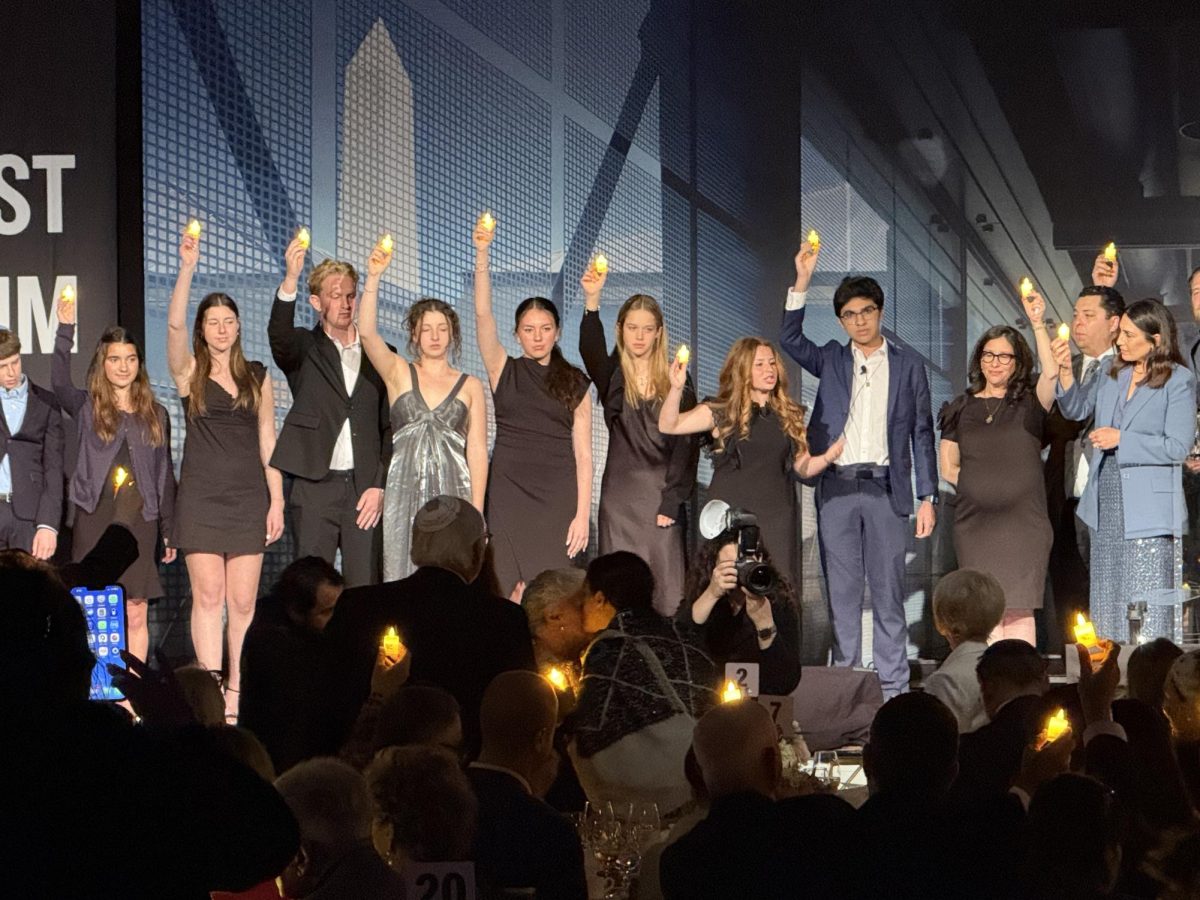
At the annual United States Holocaust Museum Memorial Dinner on Thursday, March 12th, a group of students applied and were chosen to represent their school at the tribute dinner. One of those students, Noah Auerbach ’31 was asked how it was to represent his religion outside of the school community.
“It was a really cool experience,” Auerbach said. “It felt like I was in a room surrounded by people who support me and all the Jewish People.”
The evening kicked off with the students gathering and obtaining responsibilities. Once everything was sorted out, students offered assistance to people who were entering the event, from all backgrounds and ages, as an act of kindness.
Once the students and the other guests made it to their tables, the event started off with a video on how we can continue to learn about the Holocaust and how to always remember no matter what. he family of a Holocaust Survivor also spoke on the experiences of their grandparents in the Holocaust. Shortly after, a survivor of the October 7th attacks at the Nova Music Festival spoke on her experiences during such troubling moments.
The really touching part of the event then continued, when the Holocaust and October 7th survivors talked about their experiences and comparisons of how they were able to deal with such traumatic events and memories.
“It was very meaningful and touching to hear the survivors share their stories,” Calina Goldschneider-Andrews ’29 said. “With fewer and fewer survivors left, it’s even more important to pass on their testimonies to the future generations.”
Middle School English Teacher Alton Price has been attending this event for a few years, even as a non-Jewish faculty member. “I think it’s important for non-Jewish teens to learn about the Holocaust because it was a genocide that devastated European Jewry, Roma, people with disabilities, Jehovah’s Witnesses, LGBTQ+ people, political prisoners, and other groups targeted by the Nazi regime,” Price said. “Learning about the Holocaust helps students recognize the warning signs of intolerance, propaganda, and dehumanization in society. It also emphasizes the role ordinary people played, both those who enabled harm and those who resisted it.
Not only does Price believe it is important for Jewish students and faculty to learn about the horrifying events of the Holocaust, but he has made sure that everyone recognizes these events and that they did happen. As a child, Price read Number the Stars by Lois Lowry in middle school, which eventually led to him teaching about the Holocaust. “My reading of that book instigated a lifelong respect for and admiration of Judaism and an interest in Holocaust studies, which later evolved into a commitment to Holocaust education. I want my students to consider the long-term and deleterious effects of antisemitism, and to read rich literature that helps them understand what happens when hatred becomes rooted in society.”
As Price said, we must never forget the Holocaust and keep striving to learn more and put into practice how to support the Jewish People and defend against Anti-Semitism.


